 Bulky Buddy
Office clear-outs are a different beast from home disposal. There's a handover deadline breathing down your neck, a building management office with loading-bay rules, a service-lift booking to fight for, and a pile of desks, chairs and IT gear that all needs to be gone by a specific date — usually a Friday, usually yesterday. Get it wrong and you're paying an extra month's rent or eating a deposit deduction for a unit that isn't "returned in original condition."
This is the practical playbook for SMEs, office managers and movers clearing furniture from a Singapore office — whether you're relocating, downsizing to a smaller unit, or handing back the keys entirely.
On a tight handover date? Send photos of the space — we'll quote and schedule around your deadline.
Get an office quoteWhat an office clearance usually involves
Commercial furniture is heavier, bulkier and more modular than home stuff. A typical SME clear-out includes:
- Desks — standard, L-shaped and sit-stand (the motorised ones are heavy)
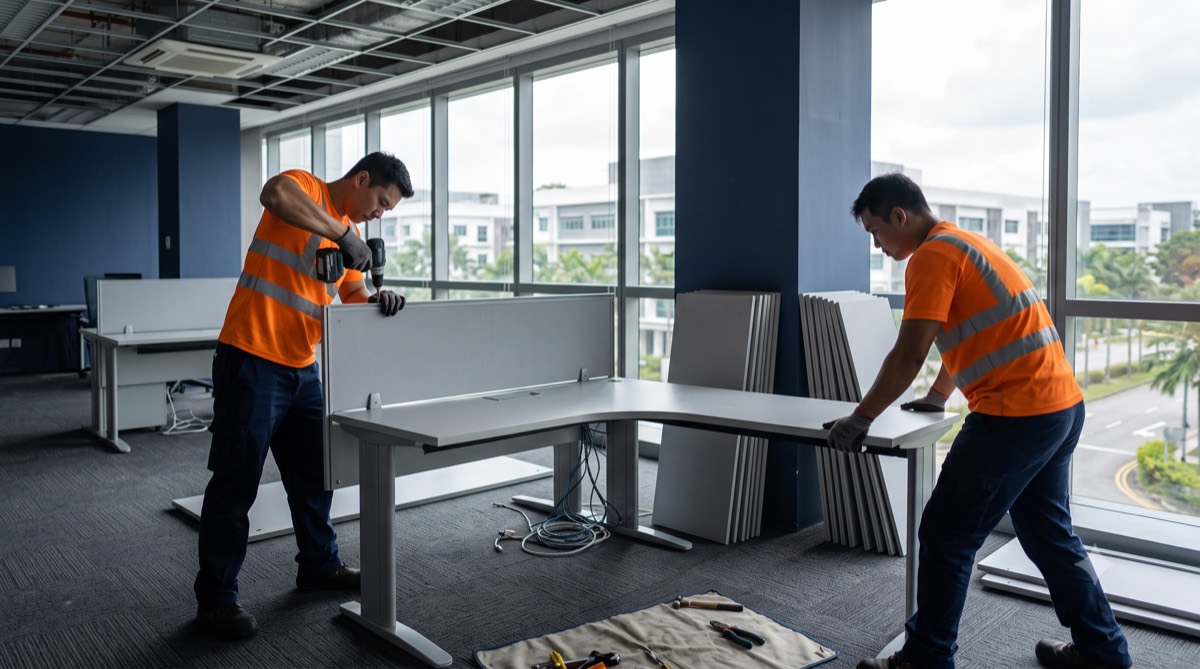
- Workstations and cubicles — pods and partition panels, almost always dismantled to move
- Office chairs — task and executive mesh, often in the dozens
- Filing cabinets and storage cupboards — brutally heavy when full; empty them first
- Conference tables — large sectional ones are a two-man dismantle
- Reception counters, pedestals, whiteboards and partitions
- Server racks and IT cabinets — heavy, and the IT gear inside is regulated e-waste
The four things that make an office job smooth
Unlike a single sofa, an office clearance lives or dies on logistics. Nail these four and the day runs clean:
1. The handover deadline
Everything works backwards from your lease end or handover date. Landlords typically want the unit cleared to bare condition, and any delay can hit your deposit. Book the clear-out with a buffer — don't schedule it for the literal last afternoon in case a lift booking falls through.
2. Building access — the real bottleneck
In a CBD tower or a business park, you don't just walk furniture out the front door. You'll usually need to:
- Book the service lift / cargo lift through building management (slots go fast near month-end)
- Reserve a loading bay window
- Clear the job with the MCST or building management office, sometimes with a deposit or insurance note
- Work within permitted hours — many buildings restrict heavy moves to after office hours or weekends
This is exactly why after-hours and weekend clearances are so common for offices — it keeps the disruption off your staff and fits the building's rules.
Insider tip: confirm your service-lift booking before you lock the disposal date, not after. The lift slot is the real constraint in most towers — furniture is easy, a fully-booked cargo lift on your handover day is not.
3. IT equipment and e-waste
Old monitors, PCs, servers and networking gear are regulated e-waste in Singapore and shouldn't go out with the general furniture. Two extra wrinkles for offices: data-bearing devices need proper wiping or destruction, and leased IT assets may have return obligations. Sort your IT disposal (or IT asset-disposal vendor) separately, and let your disposal crew handle the desks and chairs. We can route the e-waste correctly or coordinate with your IT vendor — the point is it goes through the right channel, same as the NEA e-waste rules that apply to home fridges and TVs.
4. Reuse, resale and donation
Not everything needs to be scrapped. Decent office chairs, meeting tables and cabinets often have resale or donation value — and clearing responsibly looks good on your company's sustainability reporting. A good disposer will separate what's genuinely reusable from what's headed for licensed disposal, rather than binning the lot.
What about the rest of the office waste?
Desks go on one list. Computers, confidential files, pantry refuse and reinstatement debris go on separate lists. Put a name against who clears each group to leave, then check who will take it. Our office waste disposal guide covers the routes and the IT and document questions to settle before pickup.
How pricing works for office clearances
Just like home disposal, there's no flat rate card — an office job is priced on what's actually involved. The factors that move it:
| Factor | Why it matters |
|---|---|
| Volume | Number of desks, chairs, cabinets — how many lorry trips it takes |
| Dismantling | Workstations, partitions and big conference tables are labour-heavy to break down |
| Building access | Service-lift bookings, loading-bay distance, permitted hours, high floors |
| Timing | After-hours, weekend or tight-deadline jobs need dedicated scheduling |
| Special items | Server racks, safes, heavy filing units and e-waste needing correct routing |
The same logic drives the price of a single item at home — see our sofa disposal cost guide for how size, access and dismantling stack up. For an office, you get a fixed quote for the whole clearance, and for larger sites we can do a quick look first so there are no surprises on the day.
Relocating or handing back a unit? Get a fixed office-clearance quote and a slot that fits your deadline.
Get an office quoteA simple office-clearance checklist
- Confirm your handover date and what "returned condition" the landlord expects.
- Book the service lift and loading bay with building management first.
- Separate the IT / e-waste and sort data wiping or your IT vendor.
- Flag anything reusable for resale or donation.
- Send photos + a rough item list to get a fixed quote and lock a slot with a buffer.
- Schedule after-hours or weekend if the building requires it or to spare your team.
Get it cleared without blowing the deadline
An office clearance is a logistics job first and a lifting job second — the furniture is the easy part once the lift, the timing and the e-waste are sorted. That's exactly what we do: a crew that turns up in your booked window, dismantles the workstations, clears the floor, and routes everything responsibly, so you hand back a bare unit on time.
Ready to plan it? Head to the home page or send photos of the office on WhatsApp — we'll come back with a fixed quote and a slot that fits your handover. Clearing a home at the same time? Our guides on mattress disposal and town council vs private cover the residential side.